
Methodology

Foundations for measuring access burden

MHABI is designed as a conceptual and validation-ready framework. Version 1 explains the model without displaying proprietary formulas.

Why MHABI was developed

Waiting for care can produce measurable harm across safety, functioning, acuity, and system utilization. MHABI creates a shared structure for studying that burden.
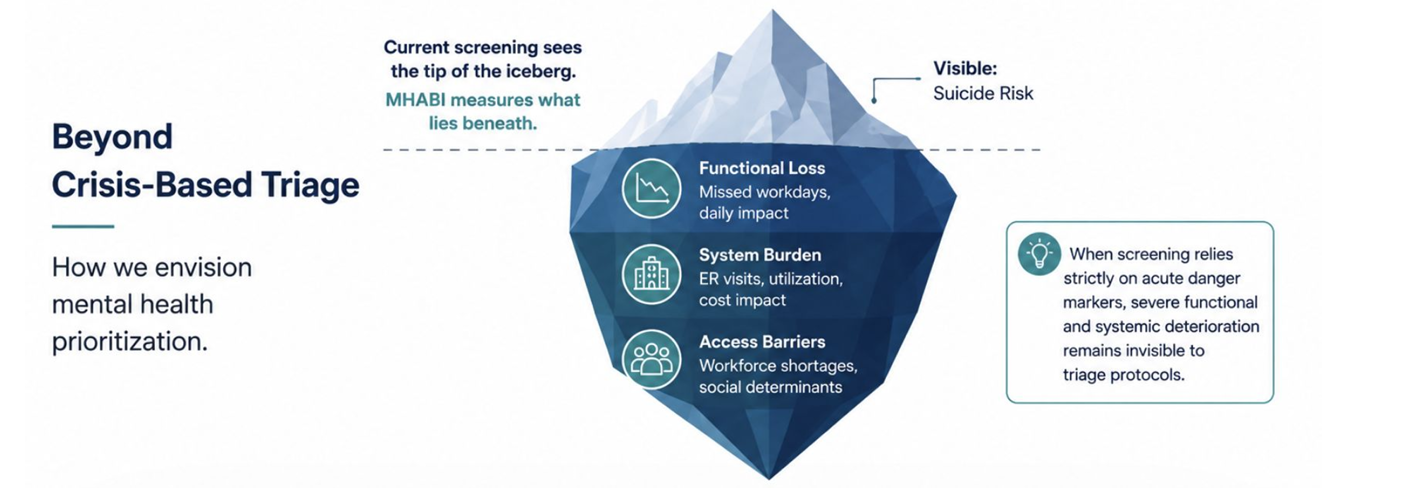
Beyond crisis-based triage: an iceberg illustrates visible suicide risk above the surface, with functional loss, system burden, and access barriers beneath it. These include missed workdays, emergency visits, workforce shortages, and social determinants.
Click or tap the illustration to view it at full size.

Dimensions

The five dimensions

Five dimensions of MHABI An illustrative five-axis radar profile, not patient data. Clockwise from the top: Suicide Risk, Access Delay, Disease Burden, Functional Loss, and ER Utilization.
Illustrative profile · Five dimensions, one framework
Axis 1

Access Delay

Time between need and care.

Axis 2

Disease Burden

Clinical complexity and severity.

Axis 3

Functional Loss

Impact on daily life and roles.

Axis 4

ER Utilization

Acute service reliance.

Axis 5

Suicide Risk

Safety indicators and clinical acuity.

Framework

Conceptual framework

MHABI connects multidimensional burden indicators to a future score that can support population-level comparison and care access planning.

Indicator domains

Define measurable signals across access, severity, function, utilization, and burden.

Index generation

Summarize burden through a validated scoring approach in future releases.

Actionable segments

Identify populations that may benefit from redesigned access pathways.

Validation roadmap

Planned validation activities

  • Refine indicator definitions and data requirements.
  • Evaluate reliability across synthetic and real-world research settings.
  • Compare MHABI outputs against access, acuity, and utilization outcomes.
  • Prepare publications and conference materials for peer review.